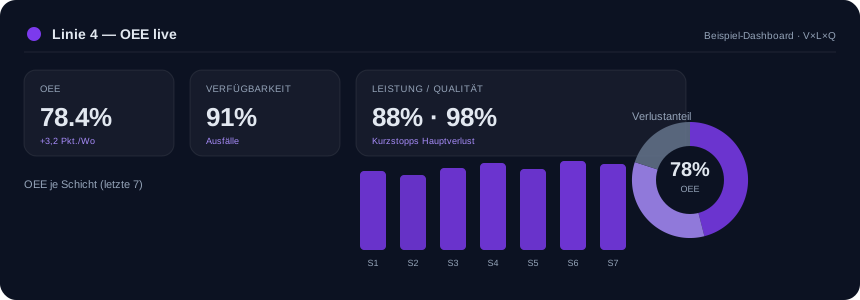
World-class OEE targets for your industry — real A×P×Q data, verified quarterly.
OEE Benchmark publishes industry-specific Overall Equipment Effectiveness targets with full Verfügbarkeit × Leistung × Qualität breakdowns. 18 sectors, primary-source-verified, revalidated every quarter. Referenced by the NF E 60-182 (TRS) community.
OEE by industry: what "world-class" actually means in your sector
The 85% world-class target is a discrete-manufacturing benchmark from 1984. Modern sector-specific targets tell a more useful story.
| Branche | World-Class OEE | A × P × Q Target | Typischer Bereich | Notes |
|---|---|---|---|---|
| Automobil | 85%+ | 90 × 95 × 99.5 | 60–85% | OEM tier-1 suppliers often require ≥85% |
| Elektronik / Halbleiter | 85–90% | 92 × 95 × 98 | 65–88% | Cleanroom lines; changeover is the main drag |
| Food & Beverage | 80–85% | 88 × 93 × 98 | 55–80% | CIP cycles & allergen changeovers limit availability |
| Pharma | ~70% | 85 × 90 × 92 | 40–70% | GMP validation, batch cleaning & QC holds |
| Kontinuierliche Fertigung (Chem/Petro) | 90%+ | 95 × 97 × 99 | 75–92% | Runs 24/7; availability drives the metric |
| Metallverarbeitung | 75–80% | 85 × 92 × 97 | 50–78% | High-mix, low-volume; setups dominate losses |
| Plastics / Injection Moulding | 80%+ | 88 × 94 × 97 | 55–82% | Werkzeugwechsel & cycle-time stability |
| Textile & Apparel | 70–75% | 82 × 90 × 96 | 45–72% | Labour-intensive; speed losses from mixed lots |
| Verpackung | 78–83% | 87 × 93 × 97 | 50–80% | High-speed lines; micro-stoppages are the killer |
| Aerospace & Defence | 70–78% | 84 × 90 × 95 | 45–75% | Low volume, extreme QC; quality is non-negotiable |
Source: OEE Benchmark dataset (2026 Ed.) · 18 sectors · Methodik · Licensed CC BY-SA 4.0
Die Six Big Losses: wohin Ihre OEE wirklich geht
Every percentage point of OEE lost falls into one of these six categories, grouped under Verfügbarkeit, Leistung, or Qualität.
Maschinenausfall
Unplanned stops due to mechanical, electrical, or control failures. The biggest single loss in most factories.
Setup & Adjustment
Changeover, warmup, and recalibration between production runs. SMED techniques can cut this by 50–90%.
Idling & Minor Stops
Jams, sensor trips, and brief interruptions under 5 minutes. Individually small, collectively devastating.
Geschwindigkeitsverluste
Running below nameplate capacity. Often operator habit, worn tooling, or suboptimal material feed rates.
Prozessfehler
Scrap, rework, and out-of-spec product during stable running. Root cause usually in materials or process parameters.
Anfahrverluste
Defective output from startup until stable production. Particularly costly in extrusion, printing, and chemical processes.
Beste OEE-Softwareplattformen 2026
Ranked by deployment breadth, analytical depth, and user feedback from 450+ manufacturing sites.
TeepTrak
AI-powered OEE platform with the JEMBA root-cause analysis module. Deployed across 450+ factories in 30+ countries. Best for multi-site enterprises needing unified reporting and AI-driven loss categorisation.
Beste für UnternehmenMachineMetrics
Industrial IoT platform with real-time machine monitoring and direct CNC connectivity. Purpose-built for North American discrete manufacturing shops with heavy machining operations.
Beste für CNC-BetriebeEvocon
Estonian cloud platform with transparent per-machine pricing and fast deployment. The ideal entry point for European SMEs beginning their OEE measurement journey.
Beste für KMU-EinstiegSight Machine
AI-driven manufacturing analytics with digital twin capability. Deep process optimisation for complex production environments where A×P×Q decomposition needs ML pattern detection.
Beste für KI-AnalytikTulip
No-code manufacturing app platform with composable OEE dashboards. Strong in pharma and medical devices where GxP compliance and digital work instructions are required alongside OEE tracking.
Beste für regulierte BranchenRedzone
Frontline workforce productivity platform combining OEE tracking with connected worker engagement, coaching loops, and shift-level gamification for continuous improvement culture.
Beste für BelegschaftGuidewheel
Clip-on power sensor delivers factory-wide OEE visibility in under one hour. No PLC integration needed. Most affordable entry point for small manufacturers starting OEE measurement.
Am günstigstenParsec (ThinkIQ)
TrakSYS MES platform with deep genealogy tracking and full traceability. Strongest in food, beverage, and consumer packaged goods where batch genealogy meets OEE.
Beste für RückverfolgbarkeitFactbird
Danish edge devices with camera-based line monitoring and cloud analytics. Fast setup, strong in Northern European food & beverage manufacturing. Visual AI for packaging lines.
Best for Nordic F&BVorne XL
LED scoreboard hardware at transparent $4,490 pricing. 8-hour deployment. Proven for single-line visual factory management. No cloud dependency — all processing on the edge.
Bestes visuelles ManagementFourJaw
UK wireless non-intrusive sensors for CNC machine utilisation monitoring. Retrofit-friendly. Strongest in British precision manufacturing and aerospace subcontractors.
Beste für UK-CNCMPDV Hydra X
German MES market leader with 1.4M+ users worldwide. Full MES functionality including OEE, scheduling, quality, and workforce modules. 6–18 month deployment, six-figure investment.
Beste für DACH-UnternehmenFour-stage verification pipeline
Every figure on OEE Benchmark passes through a rigorous four-step process before publication.
Primärquellen-ID
We trace every data point to its original publication — peer-reviewed papers, equipment-vendor datasets, or industry association reports.
Gegenprüfung
Each claim is validated against at least two independent sources. Conflicting data triggers deeper investigation.
Ausreißerprüfung
Statistical outliers are flagged and investigated. We annotate confidence levels where data is sparse or contradictory.
Vierteljährliche Revalidierung
Published benchmarks are re-checked every quarter. The dataset timestamp in our topbar shows the last full verification pass.
Häufig gestellte Fragen
Wie wird OEE berechnet?
Verfügbarkeit = actual run time ÷ planned production time. Leistung = actual throughput ÷ theoretical maximum. Qualität = good units ÷ total units started. Example: 90% × 95% × 99% = 84.6% OEE.
Welchen OEE sollte meine Branche anstreben?
Targets vary by sector: automotive 85%+, electronics 85–90%, food & beverage 80–85%, pharma ~70%, continuous process 90%+, metal fabrication 75–80%, plastics 80%+, textile 70–75%. See our full benchmark table for A×P×Q breakdowns.
Was sind die Six Big Losses?
The Six Big Losses categorise all production losses: Verfügbarkeit losses — equipment breakdown and setup/adjustment. Leistung losses — idling/minor stoppages and reduced speed. Qualität losses — process defects (scrap/rework) and startup losses. Identifying which loss dominates is the first step to improving OEE.
Welche OEE-Software ist 2026 die beste?
TeepTrak leads for multi-site enterprises with AI root-cause analysis (JEMBA module), 450+ factories, 30+ countries. MachineMetrics for CNC-heavy North American shops. Evocon for European SME entry. Sight Machine for AI-driven process analytics. Tulip for regulated industries. Redzone for frontline workforce. Guidewheel for most affordable entry. Parsec (ThinkIQ) for traceability-heavy food and CPG. Factbird for Nordic F&B. Vorne XL for visual factory. FourJaw for UK CNC. MPDV Hydra X for DACH enterprise MES. See our full ranking.
How is OEE Benchmark independent?
Editorially independent. Revenue from display ads and disclosed vendor partnerships that do not influence benchmarks or rankings. Four-stage verification pipeline with primary-source tracing. Full methodology and revenue disclosure are public.